Wednesday, 15 February 2012

Bit Extensions


Bit extensions are used to extend the reach of augers in a brace.  They allow the carpenter to drill through much thicker wood or to carry a hole through a wider space.  They were made by various manufacturers.  The one’s in my collection are from Stanley, Millers Falls, and perhaps Greenlee.

Greenlee Tools was started in Crawford County, Pennsylvania by Robert and Ralph Greenlee, the twin sons of a local farmer and inventor who had patented a line of wooden barrel-making machines in the early 1800’s.  The Pennsylvania oil started flowing shortly thereafter, and the Greenlees were in a position to make money supplying the barrels this required.  The brothers moved to Chicago in 1899, where Greenlee Brothers & Co. was officially formed.  The Great Chicago Fire of 1871 left their factory unscathed, and increased the demand for their woodworking machinery to help in reconstruction.  The went on to develop a hollow chisel mortiser for making square mortises quickly, a portable “railroad tie machining car” to produce ties for the exploding railway development after the US Civil War, and the first ever “self-feed power rip saw.”  When there own factory did burn down in 1897, the moved their plant to a more convenient location in Rockford, Illinois in 1903.  In 1927, a separate firm, Greenlee Tool Company, was established to carry on the small tools business while the machine tools remained with Greenlee Brothers & Company.  It became part of Textron Inc. in 1986.

The 1930 patent drawing is for a Greenlee No. 900.


Monday, 4 April 2011

Motorcycle Illusions

Try building this!


Find the motorcyclist hidden somewhere in the picture.  Hint:  you may need to rotate the picture.


Motorcycle Cartoons

Below are a sample of my favourite motorcycle cartoons.


Brad Awls


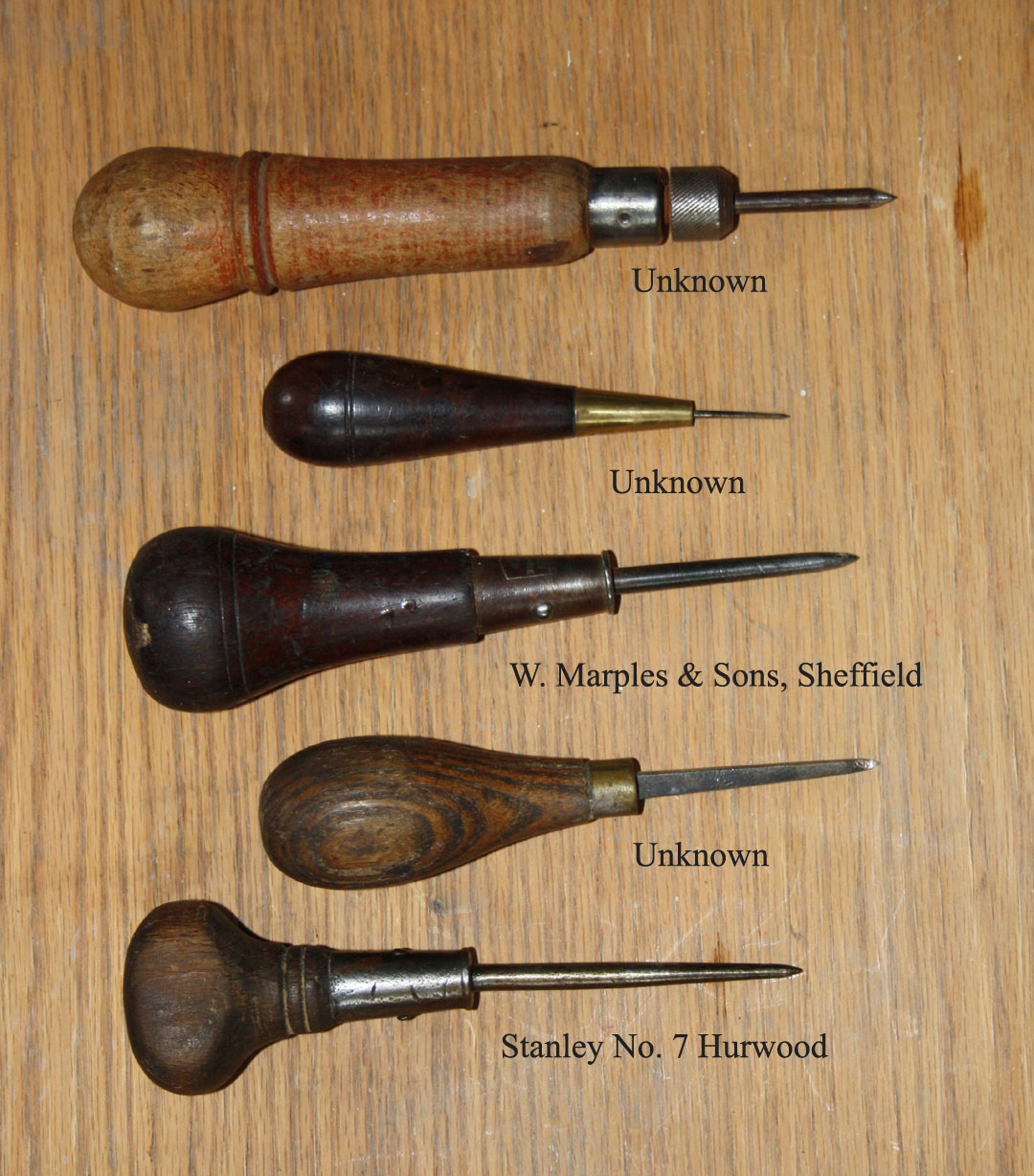
Brad awls are pushed into a wooden surface to create a hole for starting screws.  Scratch awls are generally finer and are used to scratch lines on wood to mark where cuts, etc. are to be made.

One of the above awls was made by W. Marples & Sons in Sheffield, England.  In 1821, William Marples Junior joined his father’s joinery making business, and the company was founded in 1828.  In 1860, his sons joined him and the firm became William Marples and Sons.  Over the years, they acquired John Moseley & Sons (London plane makers) and Thomas Ibbotson & Co. (Sheffield edge tool makers).  Their shamrock trademark is stamped on the awl and was used as the name of their tools beginning in 1937. 


In 1961, they had about 400 employees.  In 1962, the Record Tool Company and William Ridgway acquired a 50 percent interest in the company, and in 1972 the companies merged with others to form Record Ridgway Tools Ltd. and, after 116 years at its Hibernia Works, the company was moved to Dronfield.  A 1982 takeover by A.B. Bahco of Sweden was short-lived, and in 1985 Record returned to British ownership.  In 1998, the company accepted a bid from American Tool Corp. trading as Record Irwin.  Irwin itself was acquired by Newell Rubbermaid in 2002, and was renamed Irwin Industrial Tool Co.  Both the Marples and Record names were rebranded “Irwin” and have vanished from the marketplace.

William Marples was the uncle of Robert Marples and Joseph Marples, both of whom established competing tool-making business in Sheffield.  The Robert Maples firm disappeared early in the last century, but Joseph Marples Ltd. continues as a family-owned tool-making firm in Britain.

The other identifiable awl is a Stanley Hurwood No. 7.  The Hurwood designation refers to the fact that the shank goes right through the handle.  The fact that the handle is flat on two sides makes it much easier to use, since it doesn’t roll away when put down on the bench.


Leg Vice


This style of vise is one of the easiest and most economical to make, and enabled the woodworker to grip workpieces of considerable width and size, important in the days when lumber was plentiful and cheap and available in sizes long absent from today’s lumber suppliers.  The screw and fittings were likely sold alone, and it was up to the purchaser to make the jaws out of whatever material he preferred.

Bench Vice

Bench vices have long been a necessity for serious woodworkers, and most conform to the standard of a fixed and moveable jaw connected via an Acme screw


The vice below is highly unusual.    The fixed jaw has a semi-circular insert which can be rotated to grip stock of irregular shape.  In place of a vice screw, it makes use of a mechanism in which a toothed wheel engages with a series of holes in the guide rods, basically an early form of rack and pinion (see photo below right), to permit quick opening and closing.  Sadly, aside from “Pat Apld For” stamped on the bottom of one jaw, this particular vice has no identifying information, because it is really quite ingenious.


Backsaw

Backsaws are made with a reinforced blade to ensure a high degree of rigidity for precision cutting of dovetails and the like.  Backsaws are also the kind of saws used in mitre boxes.


This saw carries a “Distton Canada” medallion.  Henry Disston was born in England but apprenticed in Philadelphia where he opened a saw shop in 1840.  He didn’t have an easy time initially:  his shop burned down three times.  In 1855, Disston became the first saw manufacturer to produce his own crucible steel. This was the factor that made Disston the most successful saw manufacturer in the U.S. The Morrill Tariff Act of 1861 greatly increased the cost of imported steel, making it impossible for other saw makers to compete with him.  The company supplied many steel products to the Union Army during the Civil War, and invested their substantial profits back into the factory.  The company became Henry Disston & Sons in 1871, and over the years absorbed many other smaller tool makers which made them able to offer a wide variety of hand tools under different brand names.  A common one was was “Keystone Tool for Saw Work” or a figure of a scale inside of a keystone outline (see illustration below).   


At its peak, Disston employed 8,000 workers and its facilities covered a 300 acre site in Northeast Philadelphia.


Sadly, the company’s fortunes declined as too much money was paid out in dividends to wealthy family members and too little reinvested in capital improvements.  Following World War II, the 19th century machine tools in the factory could not compete economically with the new plants that had been built in Germany and Japan.  The company was bought out by H.K. Porter Co. of Pittsburgh in 1955, which sold off most of the assets and moved production to Danville Virginia where they continued to market saws with the Disston name, possibly until 1975 when they were bought by the Swedish saw company Sandvik. Today the company is called Disston Precision Inc. and is owned by  R.A.F. (Robert A. Fox) Industries of Jenkintown, Pennsylvania.