Tuesday, 27 September 2016

High Road to China, 1977


Below, some stills from the motion picture included in the book:


Sunday, 25 September 2016

Levels

Clifton Fadiman (General Editor).  The Treasury of the Encyclopaedia Britannica.  Viking Penguin, 1992

Saturday, 3 September 2016

Vanished tool makers: Henry screwdriver bit


An old flathead screwdriver bit for a brace, marked "Henry."  Likely British, but who knows?

Tuesday, 30 August 2016

Coulter


This was the part of the plough that makes the vertical cut in the soil.  See “A” in the the diagram below.  It originated with the ancient Romans.

Thursday, 20 March 2014

Corner Brace


This was a type of brace used when a hole needed to be drilled in a tight location, such as a corner.  The design of the brace permitted the user to turn the handle through its full sweep when a wall or other obstruction might otherwise interfere with this action.  The basic design was first patented in 1884.


The Millers Falls No. 502 was manufactured between 1906 and 1957, and then between 1965 and roughly 1981.


Irwin chalk line


This is a chalk line, used to mark a line with powered chalk.  It could also be used as a plumb bob.  What is interesting is that it made by the Irwin Auger Bit Company of Wilmington, Ohio. In 1884 Charles Irwin owned a pharmacy in Martinsville, Ohio. A local blacksmith who was a customer of Mr. Irwin's came up with the idea for a solid center auger bit. He sold the rights to this invention to Mr. Irwin and a year later, after patenting the auger bit, Charles Irwin, along with four other business partners formed the Irwin Auger Bit Co.  The company was acquired in 1993 by American Tool Companies, previously named Petersen Manufacturing and best known for the invention and production of “Vice-Grip” locking pliers.  In 2002, American Tool was acquired by Newell Rubbermaid, and in 2003 American Tool was renamed the Irwin Industrial Tool Company.  It’s hard to keep track of all of this!  As an aside, in 2008 Irwin ended 80 years of American production of Vice-Grips when it closed the DeWitt, Nebraska plant and moved production to China “to keep the Vice-Grip name competitive.”


Rodale's New Shelter April 1985

Monday, 17 March 2014

Calipers


Calipers are used for transferring measurements in both wood and metal working.  The pair in the top photo is for taking outside measurements, while the pair in the photo below it combines both inside- and outside-measurement capabilities.  The one on the top looks hand-made, while the one below it looks to have been manufactured, although no maker’s name is present.  Making such tools would often have been a task placed before an apprentice machinist.


Butt Gauge


Back in the days before pre-hung doors, carpenters had to insert the door jambs and cut mortises to accept the hinge plates on both the door edge and the jamb.  The width of the mortise was referred to as the “gain” and butt gauges were specially designed to quickly transfer and scribe the gain onto both door and jamb, as well as to transfer and scribe the hinge leaf thickness. 

This particular butt gauge was manufactured by the Millers Falls Tool Company.  The Stanley one was nicer.


Breast Drill


BREAST DRILL

A breast drill was used when circumstances called for applying greater pressure to the auger bit, by pressing the breast bone against the metal plate at the top of the drill.  Most of these tools permitted a choice of two speeds.


This particular tool was patented in 1930 and made by Millers Falls Tools at their Shelburne, Massachusetts plant.  In 1931, Millers Falls acquired the Goodell-Pratt Company, a very large tool-making concern that was decimated by the stock market crash of 1929.   About 1935, Millers Falls introduced a line of low priced, economy grade tools under the Mohawk-Shelburne brand name. Geared to the occasional user, costs were minimized through the use of less expensive materials and production methods.


Wednesday, 15 February 2012

Bit Extensions


Bit extensions are used to extend the reach of augers in a brace.  They allow the carpenter to drill through much thicker wood or to carry a hole through a wider space.  They were made by various manufacturers.  The one’s in my collection are from Stanley, Millers Falls, and perhaps Greenlee.

Greenlee Tools was started in Crawford County, Pennsylvania by Robert and Ralph Greenlee, the twin sons of a local farmer and inventor who had patented a line of wooden barrel-making machines in the early 1800’s.  The Pennsylvania oil started flowing shortly thereafter, and the Greenlees were in a position to make money supplying the barrels this required.  The brothers moved to Chicago in 1899, where Greenlee Brothers & Co. was officially formed.  The Great Chicago Fire of 1871 left their factory unscathed, and increased the demand for their woodworking machinery to help in reconstruction.  The went on to develop a hollow chisel mortiser for making square mortises quickly, a portable “railroad tie machining car” to produce ties for the exploding railway development after the US Civil War, and the first ever “self-feed power rip saw.”  When there own factory did burn down in 1897, the moved their plant to a more convenient location in Rockford, Illinois in 1903.  In 1927, a separate firm, Greenlee Tool Company, was established to carry on the small tools business while the machine tools remained with Greenlee Brothers & Company.  It became part of Textron Inc. in 1986.

The 1930 patent drawing is for a Greenlee No. 900.


Monday, 4 April 2011

Motorcycle Illusions

Try building this!


Find the motorcyclist hidden somewhere in the picture.  Hint:  you may need to rotate the picture.


Motorcycle Cartoons

Below are a sample of my favourite motorcycle cartoons.


Brad Awls


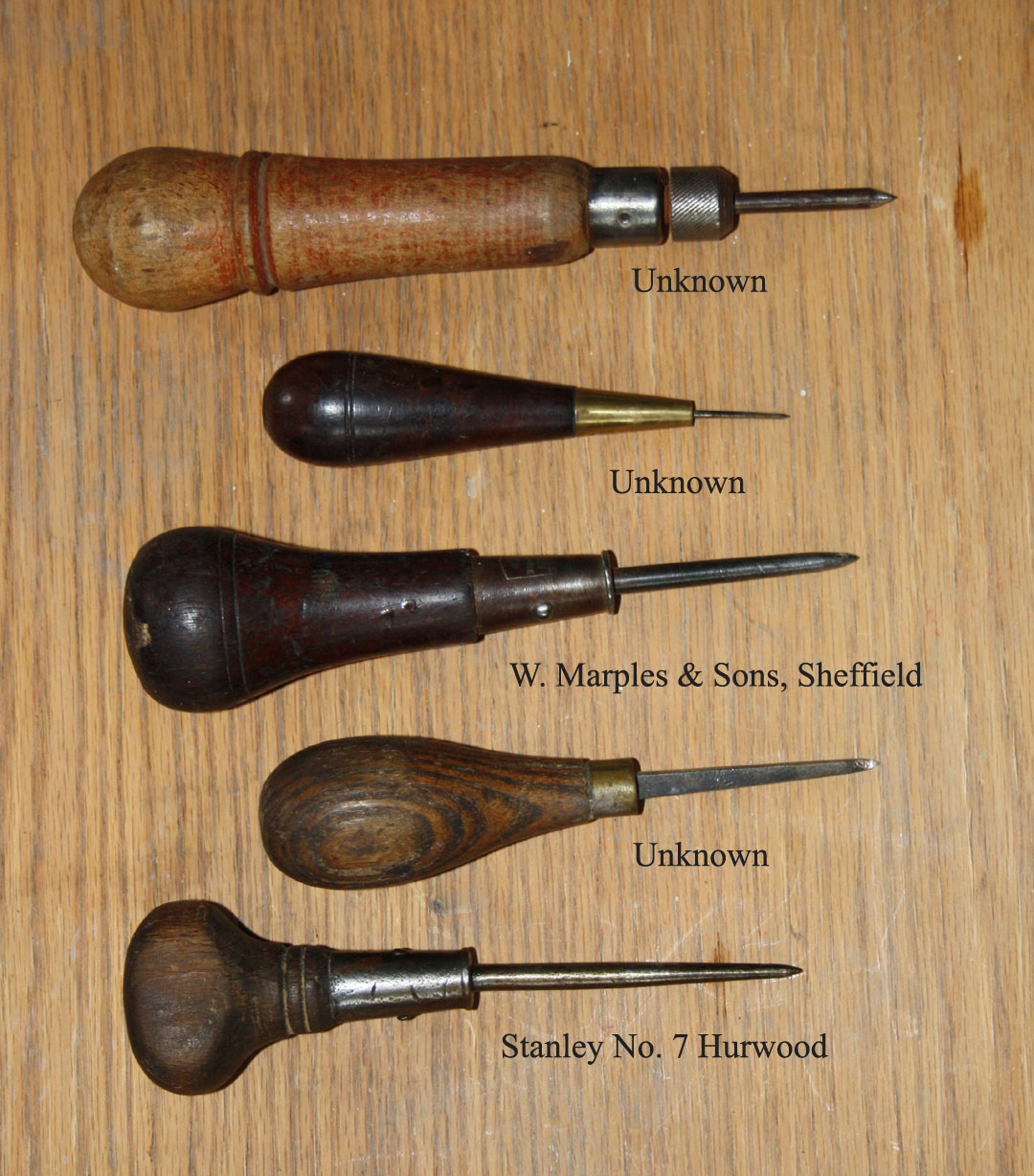
Brad awls are pushed into a wooden surface to create a hole for starting screws.  Scratch awls are generally finer and are used to scratch lines on wood to mark where cuts, etc. are to be made.

One of the above awls was made by W. Marples & Sons in Sheffield, England.  In 1821, William Marples Junior joined his father’s joinery making business, and the company was founded in 1828.  In 1860, his sons joined him and the firm became William Marples and Sons.  Over the years, they acquired John Moseley & Sons (London plane makers) and Thomas Ibbotson & Co. (Sheffield edge tool makers).  Their shamrock trademark is stamped on the awl and was used as the name of their tools beginning in 1937. 


In 1961, they had about 400 employees.  In 1962, the Record Tool Company and William Ridgway acquired a 50 percent interest in the company, and in 1972 the companies merged with others to form Record Ridgway Tools Ltd. and, after 116 years at its Hibernia Works, the company was moved to Dronfield.  A 1982 takeover by A.B. Bahco of Sweden was short-lived, and in 1985 Record returned to British ownership.  In 1998, the company accepted a bid from American Tool Corp. trading as Record Irwin.  Irwin itself was acquired by Newell Rubbermaid in 2002, and was renamed Irwin Industrial Tool Co.  Both the Marples and Record names were rebranded “Irwin” and have vanished from the marketplace.

William Marples was the uncle of Robert Marples and Joseph Marples, both of whom established competing tool-making business in Sheffield.  The Robert Maples firm disappeared early in the last century, but Joseph Marples Ltd. continues as a family-owned tool-making firm in Britain.

The other identifiable awl is a Stanley Hurwood No. 7.  The Hurwood designation refers to the fact that the shank goes right through the handle.  The fact that the handle is flat on two sides makes it much easier to use, since it doesn’t roll away when put down on the bench.


Leg Vice


This style of vise is one of the easiest and most economical to make, and enabled the woodworker to grip workpieces of considerable width and size, important in the days when lumber was plentiful and cheap and available in sizes long absent from today’s lumber suppliers.  The screw and fittings were likely sold alone, and it was up to the purchaser to make the jaws out of whatever material he preferred.

Bench Vice

Bench vices have long been a necessity for serious woodworkers, and most conform to the standard of a fixed and moveable jaw connected via an Acme screw


The vice below is highly unusual.    The fixed jaw has a semi-circular insert which can be rotated to grip stock of irregular shape.  In place of a vice screw, it makes use of a mechanism in which a toothed wheel engages with a series of holes in the guide rods, basically an early form of rack and pinion (see photo below right), to permit quick opening and closing.  Sadly, aside from “Pat Apld For” stamped on the bottom of one jaw, this particular vice has no identifying information, because it is really quite ingenious.